
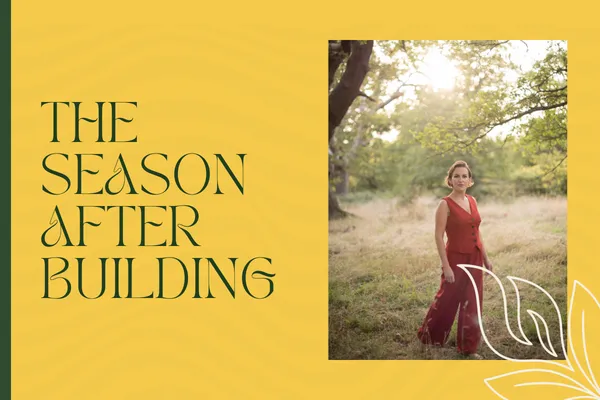
The Season After Building
Nobody really talks about what happens after you've done it.
After the business is running. After you've navigated the hard years, made the pivots, and built something that by any reasonable measure is working. There's an enormous amount of content designed to help you get there. Then you get there, and the conversation more or less stops.
What I see in my work, and I've sat in enough boardrooms, strategy sessions, and very frank conversations with people who've built genuinely significant things to say this with some confidence, is that this phase is where the most consequential decisions actually get made, quietly. Often without the right support around them. And frequently while carrying a version of themselves that was shaped by the building, not by what they've become since.
That gap, between who you were when you were proving yourself and who you are now, is where I do some of my most interesting work.
The questions are different now
When you're in the building phase, the questions have a certain clarity to them, even when they're hard. They're largely about execution and survival. What does this need to look like? How do I make this work? Can I actually pull this off? You're moving fast enough that the questions almost answer themselves through action.
The season after building is a different kind of cognitive experience altogether. The urgency drops. The clarity that came from having an obvious next target starts to dissolve. And what replaces it is something that high-performing people often find genuinely uncomfortable: open space. A set of decisions that don't have a clear right answer, that require you to know what you actually want rather than what the next logical step is.
What stays in the business and what gets released. Whether the way you've been working still suits who you are now. What you're building toward, and whether that destination still means what it used to. These aren't questions that spreadsheets or strategy frameworks resolve, and I think most people at this level know that, even when they're still reaching for those tools out of habit.
It's rarely a strategy problem
This is something I have seen many times, having worked across industries and with people at genuinely different levels of success. Including, for a period, working in Global Corporates in London and the Middle East. Somewhere the gap between surface-level strategy and what was actually driving decisions was often enormous and fascinating. The intelligence and capability in the room were never the limiting factor. It rarely is at this level.
What limits people is subtler; it's the operating patterns that were formed under pressure and never got updated. The identity that calcified around a particular version of success. The nervous system that is still running threat responses that made complete sense five years ago, but are now getting in the way of the decisions that need to be made from a much calmer, more expansive place.
My training in Mindset, NLP and years spent studying the neuroscience of how people actually change rather than how we think they do, drew me toward researchers like Dr Bessel van der Kolk precisely because of this. The body holds the operating system. You can have exceptional strategic clarity and still find yourself making decisions from a place that's more reactive than you'd like, more constrained than your actual capability warrants. That's not a character flaw, it's just what happens when the internal landscape hasn't been updated to match the external one.
What this phase actually calls for
The work I find most valuable with clients who are in this season is not just planning, though strategy absolutely comes into it. It's discernment. The ability to look clearly at what's in front of you, separate what's genuinely aligned with who you are now from what you're carrying out of momentum or obligation or an older ambition that's quietly stopped fitting, and make decisions from that place.
That requires the strategic and the internal to work together. Real clarity about the landscape, and real capacity to meet it from your current self rather than the one who did the building. When both are present, the decisions that felt genuinely heavy tend to become surprisingly straightforward. Not because the situation simplified, but because the person assessing it did.
There's a particular kind of confidence that becomes available in this phase when you stop approaching it as a problem and start treating it as exactly what it is: one of the most interesting and significant crossroads a person gets to stand at. What comes next is genuinely yours to shape, not dictated by what the business needed when it was younger.
The only real question is whether you're in the right conversation to navigate it well.
If you're in this season and ready for a different kind of conversation, get in touch at [email protected].